
“I’m Stuck!”

variable output screenshot

Something that is relatively new in the JavaScript world is the constant. For what seems like eons, JS developers have always used the ‘var’ keyword to initialize their variables. Recently, the ‘const’ keyword was introduced. This creates a variable just like var, but it is not variable…it is constant. Confused? Let me show you with an example…

[code lang=”js”]
// Create a variable and store a string in it.
var myVar = "I am a constant!";
// Output the variable to the screen.
document.writeln(myVar);
// Change the value of the variable.
myVar = "I now have different text!";
document.writeln(myVar);
[/code]

The above code would display the following…

variable output screenshot


Now let’s look at how the ‘const’ keyword works…

[code lang=”js”]
// Create a constant and store a string in it.
const myConst = "I am a variable!";
// Output the variable to the screen.
document.writeln(myConst);
// Change the value of the constant.
myVar = "I now have different text!";
document.writeln(myConst);
[/code]

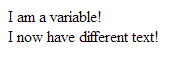
The above code would output the following…

constant output screenshot

On thing to note…you will not receive an error message or anything. You just will not be able to change to content of the constant.

This would be something to use for values within your code that will not be changing. This will ensure that you do not inadvertently change it.

Happy Coding!

More To Explore

Two white paper cup connect with red rope used for classic phone on black stone table board. For old communication system concept
Code

What is the Channel Messaging API?

The Channel Messaging API creates a private, two‑way pipe between browsing contexts. Use MessageChannel and ports to exchange data efficiently and securely.

Digital interface displaying code aligned with golden ratio in a dark futuristic room with glowing screens at a tech hub
Code

Unleashing Creativity with the Canvas API

The Canvas API stands as one of the web’s most powerful tools for creating dynamic, interactive graphics. Unlike SVG, Canvas operates at the pixel level, making it ideal for games, data visualizations, and real-time graphics processing. With a simple HTML element and JavaScript, developers can create everything from basic shapes to complex animations that push the boundaries of what’s possible in the browser.

Share This Post

small_c_popup.png

Need help?

Let's have a chat...


Login

Jump Back In!

Here at Webolution Designs, we love to learn. This includes sharing things we have learned with you. 

Register

Begin Your Learning Journey Today!

Come back inside to continue your learning journey.